


Four years after graduating from Duke University, a small group of mathematics majors was earning a median annual income of $297,029. According to federal earnings data, that was the highest figure for any undergraduate program in the dataset.
There is an important qualification: the figure represents just 17 graduates who received federal financial aid, not Duke’s entire mathematics graduating class. Still, for families weighing the cost of college against future earnings, it’s the kind of number that gets attention.
Mathematics is a foundation for many lucrative careers, particularly in technology, finance and engineering. At Duke, the mathematics curriculum accommodates students pursuing a second major and includes coursework in data science and machine learning. A student might combine mathematics with economics or computer science, developing skills that are valuable across several industries.
But the broader earnings data complicates the idea that mathematics is necessarily the most financially rewarding choice. In our comparison of figures collected by the HEA Group, computer science graduates earned more than mathematics graduates at 23 of the 24 top-50 universities reporting data for both majors. Duke was the exception.
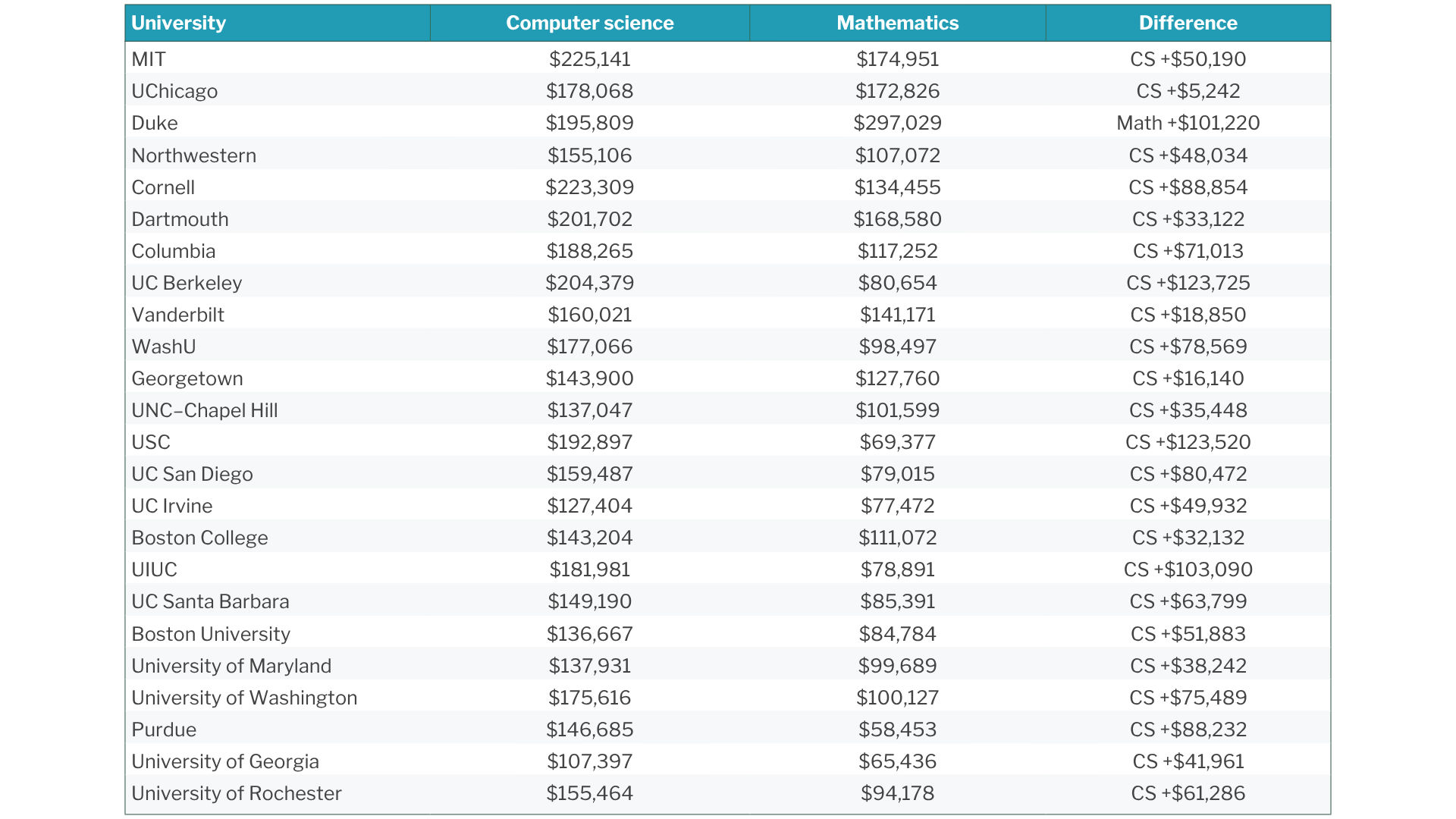
The distinction matters because a major is often treated as though it leads to a particular career, when the relationship is considerably less direct. Two mathematics graduates might enter quantitative finance and academic research. Their earnings could differ enormously, even though their diplomas say the same thing.
The same flexibility extends beyond quantitative fields. A student who loves history or art history need not abandon those interests to pursue a career in finance. Goldman Sachs recruits students from all academic backgrounds for its university programs and entry-level positions. That doesn’t mean every major offers identical prospects, but relevant coursework, internships and demonstrated skills can matter as much as the name of the degree.
College admissions conversations often focus on two decisions: where to attend and what to study. Families understandably want both choices to produce a strong return, particularly when four years at a private university can cost hundreds of thousands of dollars.
Yet earnings figures can obscure the institutional advantages that help explain them. Which employers recruit on campus? How accessible are internships and undergraduate research? Do faculty members help students build connections outside the classroom? An institution outside the Ivy League may offer an especially valuable combination of academic preparation, recruiting access and professional relationships.
These questions also complicate how families think about prestige. A university’s reputation may open doors, but the opportunities available within a particular department can be more consequential than its position in a ranking.
The Duke figure tells us something about where a small group of graduates ended up. It tells us considerably less about how they got there, or whether another student choosing the same major would follow anything like the same path. Those are different questions, even if college rankings and earnings tables encourage us to treat them as one.

Marc is the author of Untangling the Ivy League, a best-selling guidebook on the Ancient Eight. He earned a BA from Cornell University and an MBA from University of North Carolina – Chapel Hill. Marc chaired the admissions ambassadors at Cornell and the admissions advisory board at UNC.